Korean Tea and the Japanese Occupation
A thousand years of Buddhist tea culture, thirty-five years of colonial Japanese substitution, and the people who rebuilt Korean tea.
Korean tea is older than most tea drinkers outside Korea realise. The first documented imperial planting dates to 828 CE. Between then and now a Buddhist temple culture grew around tea, a Confucian dynasty nearly killed it, one monk-poet sustained it through the nineteenth century, Japanese colonial enterprise overwrote it with its own tea, and a small number of named people rebuilt what survived after 1945. This is that story.
A thousand years of Korean tea
A thousand years before Japan came
The earliest documented record is an entry in the Samguk Sagi (삼국사기 / 三國史記), Kim Pusik's 1145 official history of the Three Kingdoms. In the third year of King Heungdeok of Silla (828 CE), an envoy named Kim Dae-ryeom (김대렴) returned from Tang China with tea seeds, which the king ordered planted on Jirisan (지리산). A stone memorial at Unsuri, in Hadong county's Hwagae township, marks the claimed site.
Worth naming what this entry does and does not say. It does not say Korean tea began in 828 CE. Earlier records mention ceremonial tea offerings, including one for 661 CE involving King Suro of Geumgwan Gaya. What the Samguk Sagi documents is the first imperial planting. Tea was already in Korea, but in 828 it was brought into the state.
By the Goryeo dynasty (918-1392), tea had moved deep into two institutions. One was the Buddhist monastery, where Seon (선 / 禪, the Korean name for Zen) monks drank tea during meditation and offered it to buddhas as daily practice. The other was the royal court, which operated an office called the Dabang (다방 / 茶房) to serve tea at state ceremonies and receptions of Chinese envoys. Both institutions ran for centuries.
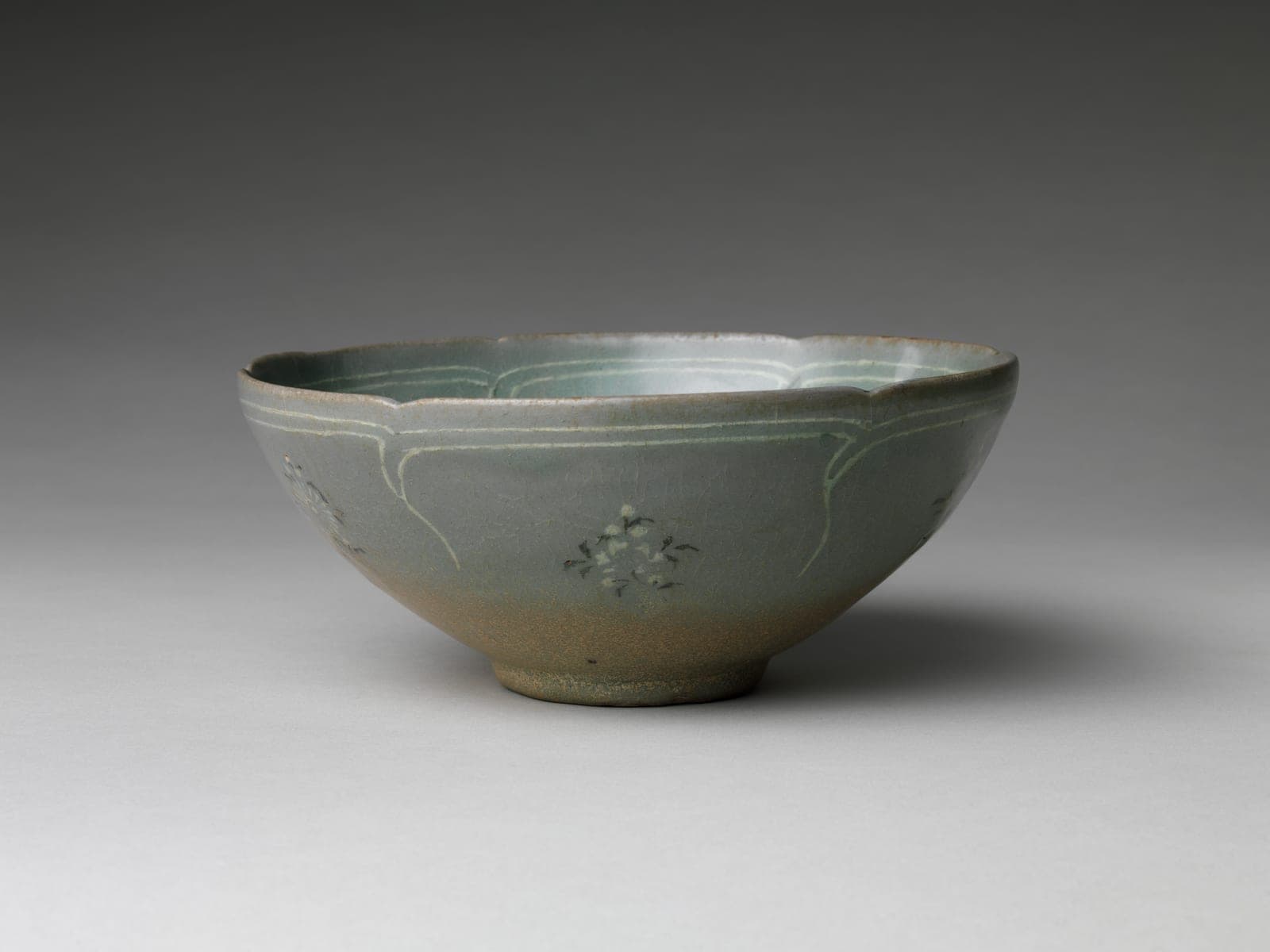
Out of this grew the twelfth-century golden age of Goryeo celadon (고려청자), particularly the inlaid sanggam (상감) technique that has no clear Chinese parallel. The Cleveland Museum of Art frames its Goryeo collection around this link: a Buddhist, meditation-adjacent tea culture drove demand for tea ware, and Korean potters responded with jade-coloured bowls that Chinese and Japanese markets began to imitate. The tea drove the ceramics, and the ceramics went out into the world.
How Joseon hollowed tea out
In 1392 the Joseon dynasty founded itself on the ideology of sungyu eokbul (숭유억불 / 崇儒抑佛, “revere Confucianism, suppress Buddhism”). This was not just rhetoric. Large Buddhist temple landholdings were confiscated, monastic orders were expelled from the capital, and Confucian ancestral rites replaced Buddhist ceremony at court.
When Buddhism was pushed out, tea went with it. Court Dabang culture wound down. The surviving monasteries retreated to the mountains of the far south, Jeolla and southern Gyeongsang, and shrank. Wine supplanted tea as the formal drink of scholars and officials.
By the 1590s, during the Imjin War against invading Japanese forces, the Ming commander Yang Hao reportedly remarked on Korea's tea potential to King Seonjo. Seonjo, according to widely cited Korean scholarship, replied that Korea had no tea-drinking custom. Whatever had been true in the Goryeo court was no longer true at the Joseon one.
What continued did so in specific mountain temples. Ssanggyesa (쌍계사) and Chilbulsa (칠불사) at the foot of Jirisan. Daeheungsa (대흥사) at Haenam. These were the embers. The nineteenth century reached for them.
Cho-ui, the exile scholar, and one hermitage
Two men in the early nineteenth century pulled the thread forward. The first was a Confucian scholar punished for his family's Catholicism. The second was a monk who came down from the mountain to learn.
Jeong Yak-yong (정약용 / 丁若鏞, 1762-1836), a reform-minded administrator and leading Silhak (실학, “practical learning”) scholar, was exiled to Gangjin in South Jeolla in 1801 after his elder brother was executed and his family was scattered. He used the exile name Dasan (다산 / 茶山, “Tea Mountain”). He stayed eighteen years and wrote roughly five hundred books. A surviving 1830 letter describes, in working detail, how to prepare a tea cake: steam the leaves three times, dry them three times, grind them fine, mix with spring water, press into cakes.
The other man was Cho-ui Uisun (초의 의순 / 草衣 意恂, 1786-1866), a young Seon monk from Daeheungsa. In 1809, at twenty-three, Cho-ui walked down from the temple to Dasan's exile house and asked to study I Ching and poetry with him. The friendship lasted until Dasan's death. In 1812 they co-wrote the Baekundong Album (백운동첩), twelve linked poems. Surviving correspondence suggests Dasan taught tea practice to Cho-ui, not the other way around.
In 1824, Cho-ui built a small hermitage above Daeheungsa and called it Iljiam (일지암 / 一枝庵, “Hermitage of the Single Branch”). He lived there for forty years. In 1830 he wrote the Dasinjeon (다신전 / 茶神傳, Chronicle of the Spirit of Tea), a careful adaptation of the Ming-dynasty Chinese tea classic Chalu for Korean use. In 1837, at the scholar Hong Hyeon-ju's request, he wrote the Dongchasong (동다송 / 東茶頌, Hymn in Praise of Eastern Tea), thirty-one verses and about 2,300 characters, the foundational modern Korean tea text.
The English reference edition of the Dongchasong is the 2010 translation by Brother Anthony of Taizé (안선재), Hong Kyeong-hee (홍경희), and Steven D. Owyoung, published by Seoul Selection. Brother Anthony keeps PDFs of the major Korean tea classics, along with further scholarship, on his Sogang University page; it is the most useful open English-language hub for Korean tea (anthony.sogang.ac.kr/kortea.htm).
Cho-ui is now called Dasaeng (다성 / 茶聖, “Tea Saint”). Iljiam is a pilgrimage site. This thread, one hermitage, one text, one generation of students, is what the Korean tea revival of the twentieth century had to work from.
Colonial tea was Japanese tea
Between 1910 and 1945 Korea was occupied by Japan. What happened to Korean tea during that time is where the story gets difficult to tell.
English-language tea writing tends to say the Japanese colonial administration “revived” Korean tea: industrial plantations in Boseong and elsewhere, modern processing, commercial scale. Peer-reviewed Korean scholarship rejects this framing directly. Kim Hyoun-a (김현아), in a 2022 paper in the Journal of Tea Culture and Industry Studies (차문화산업학), examined two colonial-era Japanese-run plantations and argued that they are better understood as the construction of Japanese-style tea in Korea, for Japanese colonial residents, actively shaped by the Chōsen Sōtokufu (조선총독부 / 朝鮮総督府, the colonial Government-General) to serve Japanese interests. They were not a revival of Korean tea. They were a substitution.
The actual chronology is wider than most English-language writing admits.
| Year | Location | Operator | Notes |
|---|---|---|---|
| 1911-12 | Gwangju (Mudeungsan) | (Japanese, unnamed) | Mudeung Dawon, later Samae Dawon. Earliest modern tea garden in Korea. |
| 1913 | Jeongeup (North Jeolla) | Ogawa | Cheonwon Dawon (천원다원), 9 ha, imported Japanese seed. Full crop exported to Osaka from 1923. |
| Early colonial | Gwangju | Ozaki | Used indigenous Korean tea. Actively restrained by the Sōtokufu from competing with mainland Japanese tea. |
| 1939 | Boseong | Kyeongseong Chemical (경성화학) | Roughly 90 ha. Founded on a proposal from the Sōtokufu Forest Experiment Station. |
| 1940 | Boseong | Kyeongseong Chemical | 29.7 ha replanted with Indian tea seed (Beniomare cultivar). |
The earliest operation was at Gwangju in 1911, on the slopes of Mudeungsan near Jeungsimsa temple. In 1913, Ogawa, a Japanese operator, founded Cheonwon Dawon in Jeongeup, North Jeolla, roughly nine hectares, using imported Japanese tea seed. By 1923 the entire crop went to Osaka.
A second Gwangju plantation, run by Ozaki, took a different path. It used indigenous Korean tea plants. According to Kim Hyoun-a's 2022 analysis, the Sōtokufu explicitly restrained the Ozaki operation from competing commercially with mainland Japanese tea. The operation was permitted to exist, not to succeed.
The largest plantation, the one most English-language writing treats as the beginning of colonial tea, came only in 1939. Kyeongseong Chemical leased land at Boseong. Here the story has a twist most English-language sources miss. The plantation was established on a proposal from the Chōsen Sōtokufu Forest Experiment Station (林業試験場), not the Agricultural Experiment Station. This is documented in a 2014 Japanese-language paper by Lee Geum-dong (李錦東) at Saga University. Colonial Korea classified tea not as an agricultural crop but as a forest resource. Wild-tea harvesting in Jirisan was administered under forestry. Ieiri Kazuo (家入 一雄), the colonial official who would later co-author the fullest 1940 survey of Korean tea, was a forestry official of South Jeolla Province. This is why.
The 1939 Boseong plantation was roughly ninety hectares. In 1940, 29.7 hectares of it were replanted with Indian tea seed of the Beniomare cultivar. A genetic legacy of this planting reportedly persists today: the tea plants at modern Boseong cluster with Japanese Camellia sinensis cultivars, while tea plants at Hadong and elsewhere cluster with Chinese source material. Which is to say: the Boseong plantation was, agronomically, not Korean tea.
It was also not a revival.
What happened to Korean tea?
The plantation economy is the easier part of the story. The cultural side is harder to document, but just as real.
Japanese tea ceremony, sadō (茶道), was introduced as a required subject for Korean girls in colonial public schools. A lecture by tea-culture scholar Park Hee-jun (박희준), summarised in Gyeongnam Domin Ilbo in 2012, describes the programme as “household-life transformation policy.” The point was not to teach tea. The point was to teach Japaneseness, using tea as the vector, with Korean schoolgirls as the target.
Vocabulary shifted alongside practice. The Korean term nokcha (녹차, green tea) was commercialised as a category by Japanese industry before Korea adopted it. Japanese steaming methods produced paler, lighter liquors. Colonial consumers were trained to prefer them over the darker, more aromatic teas Korean roasting produced. The older Korean pattern, which added ginger and honey and sat closer to a medicinal herb brew than to a modern steeped green tea, lost ground.
In the mountains, the damage was physical. Hadong county's historical record acknowledges “reckless deforestation during Japanese colonial era” in the wild-tea belt at Hwagae (화개), where tea trees had grown for a thousand years. Wartime timber extraction, better documented for northern Korea in David Fedman's 2020 monograph Seeds of Control: Japan's Empire of Forestry in Colonial Korea, continued south as the northern forests were exhausted. Jirisan tea was part of what fell.
Korean tea did not completely disappear. But what remained at the end of the occupation was substantially smaller, more marginal, and more dependent on the few people willing to keep it than it had been in 1910.
What survived, and who survived it
The continuity of Korean tea through the occupation is not a large institutional story. It is a small personal one. Specific temples, specific people, in specific places.
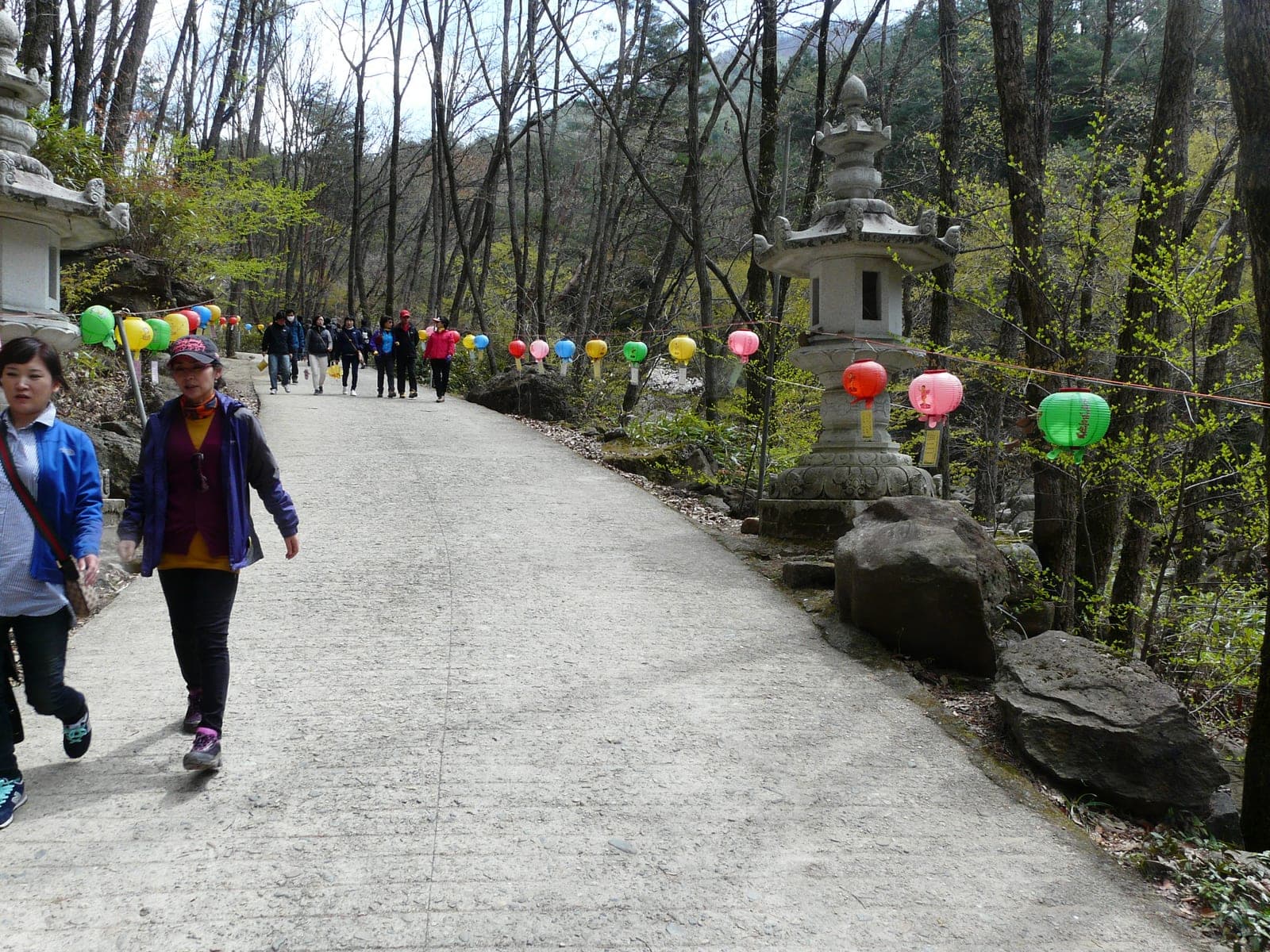
At Dasolsa (다솔사), a temple in Sacheon, South Gyeongsang, the monk Hyodang Choi Beom-sul (효당 최범술 / 曉堂 崔凡述, 1904-1979) ran both a tea hillside and an independence-movement organising centre. Hyodang had been arrested and beaten at fifteen during the 1919 March First Independence Movement. He studied at Taisho University in Tokyo in the late 1920s. In 1932, in Tokyo, he co-founded an underground Buddhist anti-Japanese organisation called Mandang (만당 / 卍黨). From 1933 he was head monk of Dasolsa, which he turned into a refuge for independence activists. He planted tea across the temple hillsides, partly in Cho-ui's memory, partly because a tea-growing monastery drew less colonial attention. He was imprisoned multiple times between 1940 and 1945. The most careful English-language account of his life is a biographical essay by Brother Anthony of Taizé in the Tripitaka Koreana research volume. Kim Sang-hyeon (김상현), the late Dongguk University Buddhist historian, later published a paper in Dongguk Sahak refuting allegations that Hyodang had collaborated with the colonial regime.
At Daeheungsa, Iljiam continued to carry Cho-ui's legacy. The hermitage was small. It kept going.
At Hadong, the monks of Ssanggyesa and Chilbulsa kept the Hwagae wild-tea fields alive as cultural heritage rather than commercial enterprise. Hadong county's narrative names the monks.
One more survival, unusual and most important. In 1939, in Gangjin (강진), the colonial forestry official Ieiri Kazuo interviewed and photographed seventy-one-year-old tea maker Yi Han-yeong (이한영, 1868-1956). Yi was the last maker of Baekun-okpan-cha (백운옥판차), a cake-tea tradition that went directly back to Cho-ui's generation. The encounter was published in 1940, under a Japanese title: Chōsen no Cha to Zen (朝鮮の茶と禅, The Tea and Zen of Chosen). Ieiri's co-author was Morooka Tamotsu (諸岡 存), a medical doctor and Komazawa University professor. Morooka wrote the first part, a textual history. Ieiri wrote the second, a field survey.
It is the fullest documentary record of Korean tea as it existed at the end of the 1930s. Korean tea scholar Jeong Min (정민) of Hanyang University calls it “the foundation text for the post-1945 Korean tea revival.” Which is to say: the document that made the twentieth-century reconstruction possible came from two agents of the colonial regime that was overwriting Korean tea. Both things are true. The book is held at Japan's National Diet Library. Brother Anthony of Taizé hosts the scanned Japanese original, and a rough English translation, on his Sogang page.
The meeting between Yi Han-yeong and Ieiri in 1939 was, demonstrably, the single transmission moment between pre-colonial and post-colonial Korean tea. One old man in Gangjin. One forestry official with a camera. One book.
Rebuilding after 1945
Liberation came in August 1945. The Boseong Kyeongseong Chemical plantation was abandoned. Hyodang came out of prison. Dasolsa survived. So did Iljiam.
The rebuilding took a generation. It happened along two main lines.
The southern Buddhist line ran through Hyodang. In 1966 he published Hangukui Chasaenghwalsa (한국의 차생활사, History of Korean Tea Life). In 1973 he followed with Hangukui Chado (한국의 다도, The Korean Way of Tea), roughly three hundred pages, the first comprehensive Korean-language study of Korean tea. He developed Panyaro (반야로 / 般若露, “Dew of Enlightening Wisdom”), a steamed-green tea style using the Korean jeungcha (증차) method, distinct from Japanese sencha or Chinese roasted greens. In January 1977, at Dasolsa, he founded the Korean Association for the Way of Tea (한국차도회). When he died in 1979, his widow Chae Wonhwa (채원화) continued the work. In July 1983 she founded the Panyaro Institute for the Way of Tea in Insa-dong, Seoul, which she still directs. Hyodang's calligraphic motto, chado mumun (차도무문 / 茶道無門, “the way of tea has no gate”), reads as meaning tea is accessible to everyone.
The urban-court line ran through Myeongwon Kim Mi-hee (명원 김미희 / 明園 金美熙, 1920-1981). She held the first Korean tea culture research conference in 1979. On 7 November 1980, at the Sejong Cultural Center in Seoul, she presented a four-part reconstruction of Korean tea ceremony: royal court ritual (궁중다례), Buddhist temple ritual (불교다례), everyday ritual (생활다례), and guest-greeting ritual (접빈다례). These are now the accepted Myeongwon darye (다례). Her daughter, Kim Ui-jeong (김의정), has held Seoul Metropolitan Intangible Cultural Heritage No. 27 for the Royal Court Tea Ceremony since 20 December 2001, and chairs the Myeongwon Cultural Foundation (명원문화재단).
Both reconstructions were real. Both rested on fragments. And both were helped along, in the 1970s, by the Park Chung-hee (박정희) government's nationalist cultural policy, which sought to rebuild traditional Korean arts as part of a post-war identity programme. A peer-reviewed 2022 paper by Lee Haeng-Cheol and Kwon Seok-Hwan describes modern cha-rye (차례) as “an invented tradition” of that era. The framing is historically accurate. It is not a debunk. Traditions are how cultures remember themselves. The Korean tea ceremony taught today did not come forward unbroken from Silla. It was put back together by named people in specific places, and that it was put back together rather than inherited unbroken is part of what makes it Korean.
A third line, less focused on ceremony, ran through industry. In 1979 the Amorepacific founder Suh Sung-hwan (서성환) began reclaiming volcanic land on Jeju for tea cultivation. The OSULLOC (오설록) brand followed. The OSULLOC Tea Museum opened at Seogwang Tea Garden in September 2001. Today it is one of Asia's most-visited tea museums.
Boseong and Hadong today
Two places carry most of the weight of contemporary Korean tea, and their origins could not be more different.
Boseong (보성) is the plantation. In 1957 the Korean entrepreneur Jang Young-seop (장영섭) bought the derelict Kyeongseong Chemical land, restored the tea fields, and rebuilt the operation as Daehan Dawon (대한다원). By 1973, Boseong's plantations accounted for about 74% of Korea's tea cultivation area. Today, Daehan Dawon is the most-photographed tea landscape in Korea, a tourist destination, a site of Korean tea industry. It is also, in institutional lineage, the direct descendant of the 1939 colonial plantation. The tea plants there still cluster genetically with Japanese cultivars. Both things are true at once.
Hadong (하동) is the wild mountain. Tea trees have grown on the southern slopes of Jirisan near Hwagae for more than a thousand years. The colonial deforestation damaged but did not extinguish them. Land-use changes after the 1961 coup removed more of them: the hillsides were converted to fruit orchards for a time. What remains was designated a national monument in 1983 and, in 2017, a Globally Important Agricultural Heritage System by the UN FAO. The Hadong tradition is smallholder, temple-adjacent, wild-leaf or semi-wild, with producers working a few hundred kilograms a year from family plots. It is what the 828 founding story was about.
Jeju (제주) is the third place. The Amorepacific Seogwang garden started from nothing in 1979 on land no one else wanted. The volcanic soil and the ocean mist give Jeju tea its own mineral character.
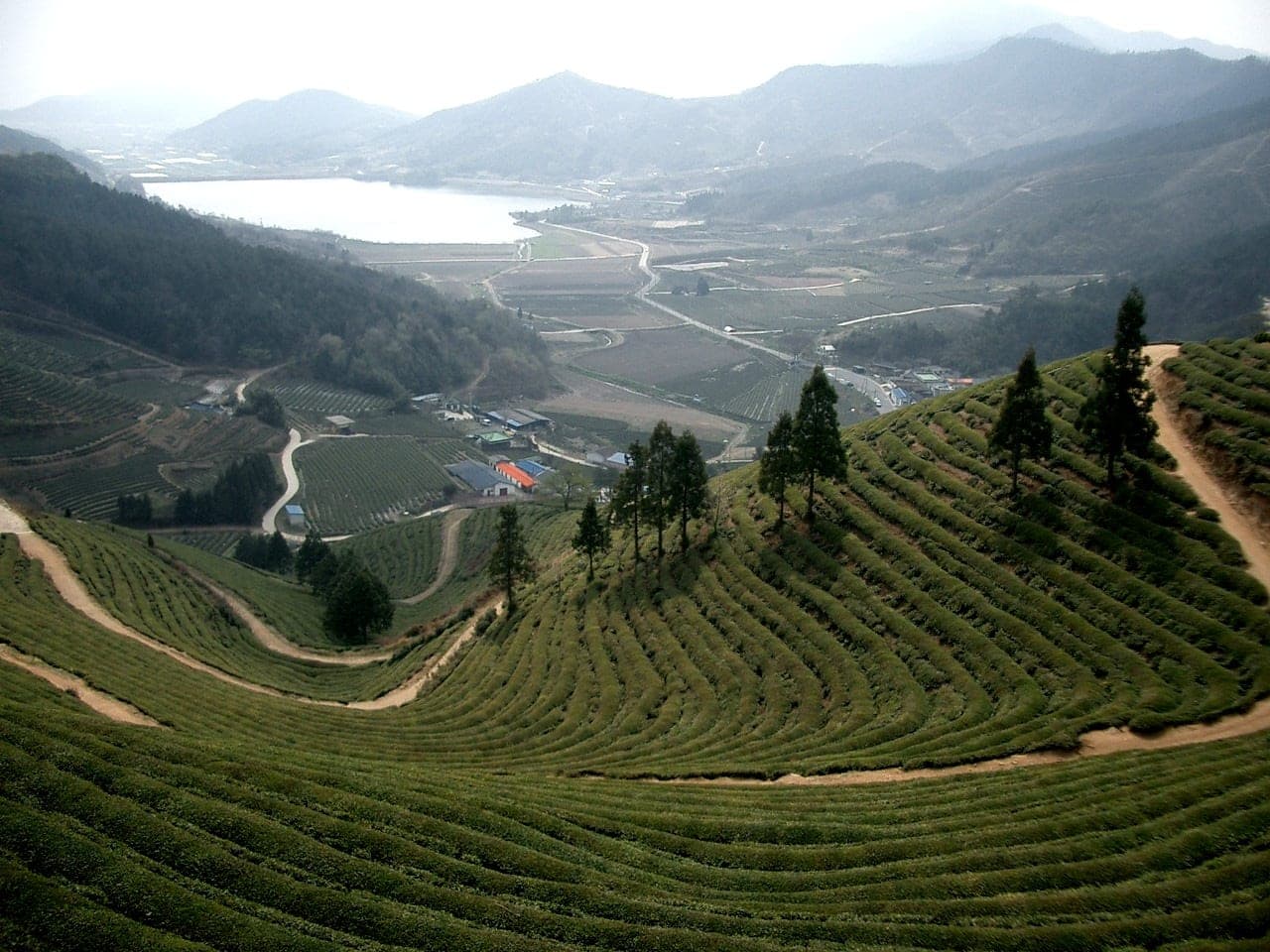
All three are Korean tea now. Their arrival stories differ fundamentally. When you drink something from Boseong and something from Hadong, you are drinking two answers to the same question.
Drinking Korean tea
Most Korean green tea is pan-fired, not steamed. The Korean method is called deokkeum (덖음) and produces a slightly darker, slightly more aromatic cup than the Japanese steamed style. Vocabulary for the grades comes from the solar calendar and the shape of the bud.
| Grade | Hangul | Timing | Character |
|---|---|---|---|
| Ujeon | 우전 (雨前) | Before 20 April (Gogu) | Tender bud, floral, sweet |
| Sejak | 세작 (細雀) | Late April | First leaf unfurling |
| Jungjak | 중작 (中雀) | May | Fuller body, rounder |
| Daejak | 대작 (大雀) | After early June | Darker, more astringent |
Ujeon is prized and expensive. Daejak is everyday. The sparrow-tongue imagery parallels the Chinese queshe (雀舌).
One thread of Korean post-fermented tea remains: Cheongtaejeon (청태전 / 靑苔錢, “moss-green coin”) from Jangheung in South Jeolla: small round coin-cakes with a hole through the middle, steamed, pressed, aged. It is what remained of the older Korean brick-tea tradition (doncha, 돈차, “money tea”) after the twentieth century. Jangheung Dawon is making it again, sometimes as twenty-five-year aged cakes.
Four ways into Korean tea
A good way in: a Hadong-grown Sejak, brewed in a small porcelain teapot, 70 to 75 degrees, generous leaf, short infusions. The tea should taste green but round, not sharp. If you can find a Jangheung Cheongtaejeon, drink it slowly and think about the thousand years of coin-cakes behind it.
More like this
Explore TEAKI Articles